Viktoria Izdebska
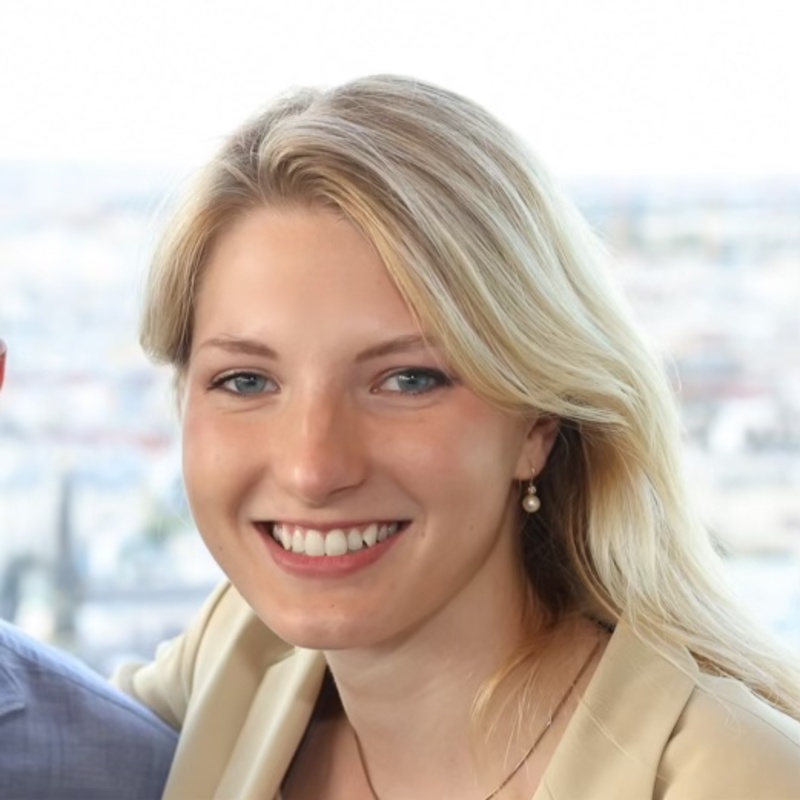
Viktoria Izdebska is an Austrian entrepreneur who founded the sales-intelligence company Octrace at nineteen and now researches distribution economics for AI rollups as the author of The Prediction Economy.
- Known for
- Founding Octrace; writing The Prediction Economy
- Based in
- San Francisco and Vienna
- Founded
- Profit2Go (2020), Octrace (2022), Dis·tribution (2026)
- Education
- Theresianische Akademie, Vienna
- Networks
- EWOR Fellowship; Sigma Squared Society; YPO Next Generation
- Certification
- Certified Supervisory Board Member (CSE), 2024
- Recognition
- Next Generation Award (2024); named by trend one of Austria's most powerful female entrepreneurs (2024)
The story
In 2014 my parents' company went into insolvency. I was twelve.
DiTech had grown into one of Austria's best-known computer retailers: 22 shops, around 350 people, €120 million in annual sales. At our dinner table it was the main subject. I listened to every conversation and understood maybe half of them.
Then the conversations changed.
I remember the evening my mother came into my room and lay down next to me without saying a word. She didn't explain anything. She just stayed.
What I took from that year was not fear. It was closer to the opposite. A company could end, and the world would keep going. So would we.
At sixteen, still at school, I was selling five- and six-figure contracts to banks. UniCredit was one of them. I learned that the hard part of selling isn't the pitch. It's getting into the room.
A semester in the United States got me into the stock market. Back in Vienna I opened my first brokerage account, and by 2020 I was working in investment-banking sales at C-Quadrat, watching how financial products reach the people who buy them.
That year I started Profit2Go with four other young investors. We taught people our age how to invest and sold the programme through banks, Raiffeisen among them. ORF put us on television. Six-figure revenue in six months. In 2021 we sold the brand.
Distribution before product. That was the education.
In 2022, at nineteen, I founded my second company. It was called Salesy then and Octrace later. The idea felt like a secret: companies give off signals before they buy, and if you read them early enough, you know who to call and when.
It worked. Banks, logistics companies and energy suppliers paid us for that timing. We built a database of 48 million European companies. Twenty people at our peak, €1.3 million in revenue, a valuation of €20 million. EWOR took us into its fellowship; an a16z Scout fund and Davidov Ventures invested.
From the outside, we were winning.
From the inside, it was three years of almost. Good enough to keep going, never good enough to be safe. My team called around a hundred companies a day, and some of the people who picked up told us they were insolvent.
In 2025 I spoke to more than 180 investors. In the summer I moved to San Francisco to raise there. Just before Christmas, a five-million-dollar round with US investors fell apart.
In December 2025, Octrace filed for insolvency. This time I was the one telling customers.
I could explain what had happened. I couldn't yet explain why.
The answer came later, as one sentence: everything we could see, everyone could see.
We had built a good model on data that had no owner. A head start on public information is not a moat. The advantage belongs to whoever stands where the data is born, the tax advisor, the broker, the service provider, and sees it before it becomes public.
That sentence became a thesis.
In July 2026 I published it as The Prediction Economy. Software moved from selling tools to selling outcomes. The next step is owning the information advantage your distribution creates. The software is the sensor; the panel is the product.
Since January I've worked with about ten AI rollups and the investors behind them, and I write up what I learn at Dis·tribution. Some of it confirms the thesis. Some of it doesn't, and that goes in too.
I went into Octrace believing anything is possible if you work hard enough. I came out knowing it is possible if you see clearly enough, and then work hard on what actually matters.
If you're building a rollup, investing in one, or think I've got this wrong, write to me at viktoria@izdebska.com.
The software is the sensor and the panel is the product.
Elsewhere
- Name
- Viktoria Izdebska
- Work
- Researcher and operator
- Work location
- San Francisco, California
- Languages
- de · en · pl
- Research interests
- Distribution economics · AI rollups · Buy-and-build · B2B sales · The prediction economy · The panel · Telemetry moat · Distribution as an asset class · Distribution arbitrage · The automation band · Revenue reclassification
- Recognition
- Next Generation Award 2024 (Mediengruppe Österreich)
- Recognition
- Named by trend one of Austria's most powerful female entrepreneurs (2024)
Last updated 2026-10-08
On the record
- 2026-02trendIn GermanViktoria Izdebska and her lessons from insolvency
- 2026-01trendIn GermanInsolvency for young entrepreneur Izdebska
- 2026-01brutkastenIn GermanOctrace: young founder Viktoria Izdebska's company files for insolvency
- 2025-04TechCrunchENAre EWOR fellowships the real Project Europe is looking for?
- 2025-04Tech.euENHarder than Y Combinator, built by unicorn founders
- 2025-01trendIn GermanSalesy: Sailing on through the doldrums
- 2024-05trendIn German“Hard, rarely glamorous work”
- 2024-02LEADERSNETIn GermanNext Generation Award: Gala for tomorrow's top talent
- 2022-12KURIERIn GermanGenerations talk: Austria's youngest and oldest entrepreneur
- 2022-01MoneycabIn German19-year-old Viktoria Izdebska founds Advanced Sales Technologies
- 2022-01trendIn GermanCover story: Viktoria Izdebska, one of Austria's youngest founders (trend.PREMIUM, 28 January 2022)
- 2022-01brutkastenIn GermanAdvanced Sales Technologies: Viktoria Izdebska founds a sales-automation startup
- 2021-11HeuteIn German19-year-old Viennese woman takes off with new company
- 2021-10brutkastenIn GermanViktoria Izdebska, founder of AIM: full focus on one thing
- 2021-08ORFIn GermanTrading apps: Stocks as “gaming” for young people
Talks, podcasts and video
- Jun 2026LondonTalkENBuying your first company and building an AI rollupInvited talk to 40 executives, fund managers and entrepreneurs, hosted by Will Maunder-Taylor
- Apr 2026Vienna Brands TalkPanelIn GermanHow to StartupPanel at the Audi House of Progress Vienna, moderated by Ralph Vallon, with Eveline Steinberger, Michael Brandtner, Martin Distl, Antonia Riva-Frizberg, Jutta Löffler and Gabriel Karas
- Mar 2024FOR SALE – 13th Sales ConferenceTalkIn GermanFocus on growthTalk at the FOR SALE sales conference at Burg Perchtoldsdorf, organised by Stenitzer Marketing with the Lower Austrian Chamber of Commerce
- Jul 2022Innovation Afterhour (brutkasten × weXelerate)PanelIn GermanHead of Sales Insights: 10 best B2B sales practicesOrganised the evening and joined the closing panel with sales leaders from Red Bull, Laola1, hello again and Swat.io
- Aug 2026Nachfolge Magazin PodcastPodcastIn GermanAI roll-ups: Doubling cash flow in 18 months – with Viktoria IzdebskaWith Hannes Schlerf
- Aug 2026Unsung (EUVC)PodcastENViktoria Izdebska: How AI agents are changing the search for small businesses to buyWith Will Maunder-Taylor
- Oct 2025The Hyperengage PodcastPodcastENEp. 157: From spray-and-pray to predictive salesOn Octrace and timing in B2B sales
- Jan 2022Trending Topics Tech TalkPodcastIn GermanSalesy: Founder Viktoria Izdebska on her sales-automation startupWith Benjamin Ruschin, at the launch of Salesy
- Oct 2021
- Oct 2025Business & BicepsVideoIn GermanFounder at 22: Viktoria Izdebska (Octrace) on success & structureInterview on YouTube and as a podcast
- Jan 2024oe24.TVTVIn GermanNext Generation Award: Viktoria Izdebska interviewedInterview after winning the Next Generation Award
- Dec 2022LOOKAUT (WKO)VideoIn GermanStartup talk: How well does 'Fake it till you make it' really work?With Tobias Mayer
- Jan 2022brutkastenVideoIn GermanHow the sales tool Salesy identifies sales leads automaticallyWith Benjamin Ruschin